Daily 10: The Ultimate Mental Maths Challenge to Build Confidence and Improve Number Skills
Discover how the Daily 10 maths game helps primary school children practice calculations, strengthen number fluency, and enjoy learning through quick, engaging challenges.

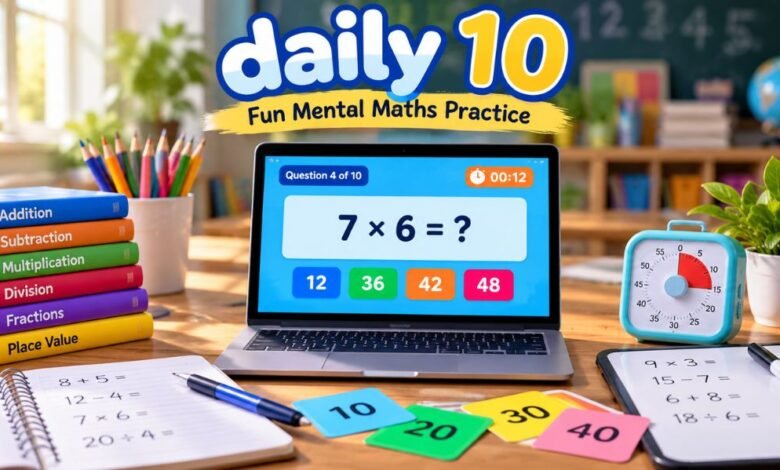
Daily 10 is a free online mental maths activity developed by Topmarks to help primary school children strengthen their mathematical skills through short, focused challenges. Designed for children aged approximately 5 to 11, the game presents ten questions covering essential topics such as addition, subtraction, multiplication, division, and fractions.
Its adjustable difficulty levels and flexible timing options make it useful for classroom teaching and independent home practice. Instead of relying on lengthy exercises, Daily 10 encourages regular practice with fundamental number skills, giving learners opportunities to build accuracy, confidence, and faster recall through manageable sessions.
What Is Daily 10?
Daily 10, also known as the Daily 10 Mental Maths Challenge, is an educational resource created by Topmarks. Topmarks launched it in December 2017 to support mathematics learning across primary school year groups.
The activity generates sets of ten questions based on a chosen mathematical topic. Teachers or learners select a difficulty level, choose the calculation type, and decide how quickly the questions appear.
Unlike traditional worksheets, the game presents questions on screen, making it suitable for classroom interactive whiteboards, tablets, and computers.
Its central purpose is to provide focused number practice without requiring children to complete an entire lesson or lengthy worksheet.
How Does the Daily 10 Maths Game Work?
The game follows a straightforward format that lets teachers and pupils start practicing with minimal preparation.
First, users select an appropriate difficulty level. They then choose a mathematical category and a specific question type within it.
Next, they decide whether questions should appear automatically at timed intervals or advance manually.
Ten questions are presented during each round. Children can write their answers on paper or a small whiteboard, then check their responses when the round ends.
The answers appear at the end, allowing learners to review mistakes and identify concepts that need more practice.
Daily 10 Maths Levels and Age Groups
The resource offers levels corresponding broadly to Years 1 through 6 of England’s primary mathematics curriculum.
Level Corresponding Year Group
Level 1 Year 1
Level 2 Year 2
Level 3 Year 3
Level 4 Year 4
Level 5 Year 5
Level 6 Year 6
These levels provide a convenient starting point rather than a strict restriction. A learner struggling with a particular concept may benefit from working at a lower level, while a confident pupil can explore more challenging questions.
Choosing a suitable difficulty is more valuable than advancing quickly. Accurate understanding provides the foundation for improved mathematical fluency.
Mathematical Topics Covered in Daily 10
One of the resource’s strengths is its range of numerical activities.
Addition and Subtraction
Children practice basic number facts, calculations, and increasingly complex arithmetic. These activities encourage familiarity with number relationships and help pupils develop efficient mental strategies.
Multiplication and Division
Multiplication tables and division facts are essential in primary mathematics. Regular practice can help children recall familiar calculations more confidently and understand the relationship between multiplication and division.
Place Value and Rounding
Place value exercises develop an understanding of how digits represent different quantities. Rounding activities encourage pupils to recognize approximate values and work comfortably with larger numbers.
Fractions and Number Relationships
The resource also includes fractions, doubling, halving, ordering, and partitioning.
These topics support broader mathematical understanding and prepare children for calculations that require several connected number skills.
Why Daily 10 Can Support Mental Maths Development
Mental maths involves calculating and reasoning with numbers without depending entirely on written procedures or calculators.
Regular practice with appropriately challenging questions can build automatic recall, especially for familiar number facts.
Daily 10 offers several practical advantages.
Focused practice: Ten questions provide a manageable activity that can fit into a busy school day.
Flexible difficulty: Learners can practice skills that match their current understanding.
Immediate review: Displayed answers allow children to identify and correct errors.
Varied mathematical content: Different topics help prevent practice from becoming limited to one type of calculation.
Adjustable pace: Timed and untimed options allow teachers to adapt the activity to different learning needs.
These features make the game a useful supplement to mathematics teaching, although it does not replace explanations, worked examples, or individual support.
How Teachers Can Use Daily 10 in the Classroom
Teachers can incorporate the challenge into several parts of a mathematics lesson.
At the beginning of class, a short round can refresh knowledge from previous lessons. This makes it a useful lesson starter before introducing more demanding work.
During a lesson, teachers can select questions connected to the concept pupils are currently learning.
At the end, another round can revisit key number facts and encourage discussion of different calculation methods.
Displaying questions on an interactive whiteboard allows the whole class to participate.
Teachers can also encourage pupils to explain how they reached an answer. Discussing strategies helps turn a quick calculation exercise into a more meaningful learning experience.
Using Daily 10 at Home
Parents can use the activity to encourage regular mathematics practice without creating an unnecessarily demanding routine.
A sensible approach is to start with familiar calculations and gradually introduce harder questions as the child builds confidence.
Children who feel uncomfortable with timed challenges can use the manual setting to work at a comfortable pace.
Parents should focus on understanding rather than simply counting correct answers. When a mistake occurs, discussing the calculation can reveal whether the difficulty lies in number knowledge, the chosen method, or a misunderstanding of the question.
Short, positive practice sessions are generally more manageable than long periods of repetitive calculation.
Timed Versus Untimed Practice
The choice between timed and untimed questions can influence how children experience the activity.
Timed practice introduces a structured pace that may help learners strengthen recall of well-understood number facts.
However, speed is not always the best measure of mathematical ability.
For children learning a new concept, untimed questions create room for reasoning, reflection, and checking calculations.
A balanced approach starts with understanding and accuracy before introducing greater speed.
Teachers and parents can adjust the settings as learners become more comfortable with the material.
Common Mistakes to Avoid
Daily 10 is most useful when children receive appropriate support, not just repeated rounds.
One common mistake is selecting questions that are too difficult. If a learner repeatedly struggles, returning to a simpler level can help reinforce essential knowledge.
Another mistake is treating speed as the only sign of progress. A child who carefully explains a correct calculation shows strong mathematical understanding, even if the answer takes longer.
Repeatedly practicing the same topic without reviewing errors can also limit progress.
Variety, constructive feedback, and gradual progression create a more productive learning experience.
Conclusion: Is Daily 10 Worth Using?
Daily 10 offers a convenient way to incorporate mental maths practice into classroom lessons and home learning. Its ten-question structure, adjustable difficulty levels, and broad selection of mathematical topics make it accessible to children with different learning needs.
The resource works best when used consistently alongside quality teaching and clear explanations. By encouraging understanding, reviewing mistakes, and selecting appropriate challenges, teachers and parents can help children develop stronger number fluency and greater confidence in mathematics.
Frequently Asked Questions About Daily 10
1. What is the Daily 10 maths game?
Daily 10 is a free online mental maths resource developed by Topmarks. Each round provides ten questions covering primary mathematics topics such as addition, subtraction, multiplication, division, fractions, and place value.
2. Is Daily 10 free to use?
Yes. Daily 10 is available as a free educational activity. Children and teachers can access the resource through the Topmarks website without a subscription or account.
3. What age group is Daily 10 suitable for?
The game is primarily designed for children aged 5 to 11. Its six difficulty levels correspond broadly to Years 1 through 6 in England’s primary school curriculum.
4. Can children play Daily 10 on a tablet?
Yes. The resource is tablet-friendly and can also be used on computers and interactive classroom whiteboards. Its browser-based format makes it convenient for different learning environments.
5. Does Daily 10 help children improve their maths skills?
Regular practice may help children strengthen number recall, calculation accuracy, and confidence. The greatest benefits come when learners understand their mistakes, practice appropriate questions, and receive support with concepts they find challenging.